Joe's Air Blog

An occasional Brain Dump, from the creator of Joe's SeaBlog

Thursday, October 22, 2009

More Health Care

One of the primary arguments against a public insurance option in the current healthcare debate is that this is a form of Socialized Medicine, and Socialized Medicine is bad. Such statements are usually followed up with anecdotes about how messed up healthcare is in England or Canada or France, because people have to wait for service (which, of course, we do in the US), and the technology lags.

The funny thing of it is, as bad as the healthcare systems are in these countries, people still live longer than they do in the US.

I've included Switzerland in the comparison below because, as Paul Krugman points out, the "Public Option" plan favored by many Democrats most closely resembles the Swiss system. And Cuba, because we all know that everything sucks in Commie Cuba.

Average life expectancy in 2007, per the World Health Organization:
Switzerland 82
Canada 81
France 81
England 80
Cuba 78
USA 78


Infant mortality rate in 2007, same source:
France 3 deaths per 1,000 live births
Switzerland 4
Canada 5
England 5
Cuba 5
USA 6

The fact of the matter is that basically all developed countries other than the US guarantee health care coverage for all their citizens. And all of them fare better in life expectancy and infant mortality rates than does the US. Do we have the best healthcare facilities in the world? Perhaps we do. But that doesn't do any good when there are 50 million people who can't get treatment because they don't have coverage. (Or often, even if they do, but that's another story.)

Let's care for our fellow countrymen, folks. Let's ensure healthcare for all.

Labels: , , ,

Monday, October 19, 2009

More Health Care Thoughts

This part two of a thought experiment about the US Health Insurance industry.

I am employed by a not-for-profit organization that provides medical and dental insurance to its employees. Employees are required to share in the cost of this program, and a variety of competitive options are provided. I opt for the so-called “80/20 plan,” in which essentially 80% of costs are covered following a $20 copay, subject to an annual deductible. I have approximately $50 withheld pre-tax from my paycheck every two weeks, for a cost to me of about $1,300. In addition, I have a Flexible Spending plan available to reimburse me for the things not covered by the plan, including vision care as well as the aforementioned copays and deductibles. For 2009, I am withholding $750 from my pay to co-insure myself for healthcare.

In all, my insurance will cost me over $2,000 this year. (Of course, my employer is also bearing a significant amount of the cost of my coverage, an amount unknown to me.) Let me reiterate – the amount of your copays and deductibles also comprise the cost of your health insurance. These are the conditions imposed by the insurance company to provide healthcare coverage. They won’t pay the bill until you pay these costs above and beyond your premiums.

Unfortunately for me, in addition to my normal checkups (physical, eye exam, two dental exams) I had one trip to the Emergency Room last winter, and I broke a tooth later in the year, which have added over $1,000 out of my own pocket to the total bill. But fortunately I am in generally good health, with no chronic issues to deal with.

The Federal Government will withhold about $5,600 in estimated income taxes from my paycheck this year. My actual final bill will likely be less than that, but for purposes of this discussion let’s use the higher number. My health insurance costs - not including the emergency situations - equal about 36 percent of my annual federal income tax bill. If the Federal Government became the sole provider of health insurance in this country, but the result was a 30% increase in my Federal income taxes – it would save me money.

Let me repeat that – I would be better off with a 30% tax increase it the tradeoff is that I have no medical bills to pay.

This is a very simplistic calculation, to be sure. For one thing, every employer is different in the amount that they ask employees to pay. Some people pay no premiums out of their own pockets, while others pay significantly higher amounts. But I have a competitive plan, and I earn more money than the average worker in this country. I also am not covering anybody else under my plan, unlike many who cover spouses and children. I suspect that most people pay more than 36% of their federal tax bill in health insurance costs.

It is for this reason that I don’t understand why a tax increase is anathema to so many. For most US citizens, publicly-provided health care coverage would put more money in their pockets. Quite the opposite to the message promoted by the conservatives, this would be an economic boon rather than a burden. Some people would have higher tax bills as a result, but those people would be the mega-rich of this country. I submit that adding a few hundred or a couple of thousand dollars to the pockets of the average American will result in greater economic stimulus than keeping it in the investment portfolios of our country’s wealthiest citizens. The middle class are far more likely to actually buy stuff with their extra cash.

Labels: , ,

Tuesday, July 21, 2009

Thoughts on Health Care

The latest political boogeyman is Universal Health Care, as proposed by the Obama administration. Lots of rhetoric is thrown back and forth on the issue, and the Right Wing, while offering little in the way of alternatives, continues to snipe at the proposal.

Some of the common themes:

It's going to lead us to socialism!
Please. For one thing, the checks and balances in our government are too strong, and the election cycles are too short, for us to become a socialist society. If the people don't want the US to become a socialist society, we'll vote out those who we think are leading us in that direction.

Besides, the government has been providing essential services that benefit the public good for a long, long time. Having a state-sponsored police force hasn't led us to socialism. Nor, for that matter, has publicly-run health care, like Medicare.

There will be a government bureaucrat standing between you and your doctor!
I'm not sure how this is worse than having an insurance industry bureaucrat standing between you and your doctor. Or between you and your reimbursement, for that matter.

Private capital is incented to operate more efficiently!
Private capital is incented to maximize profits. Sure, they might provide health insurance with fewer employees than the government will provide it with, but they are also looking for ways to get more money into the pockets of the executives and shareholders. Some of this is done by operating more efficiently. Some of this is done by increasing premiums. And some of this is done by denying coverage to people who believe they've purchased it. In a government-run universal system, there is no profit or bonus incentive, so those costs are eliminated.

As for operating efficiently - raise your hand if you've never heard of governmental entities cutting jobs? I thought so.

Government spending will increase! Taxes will go up!!!
And spending on private healthcare coverage will go down. Again, I fail to see the difference between a dollar sent to the government and a dollar sent to a private company.

You'll have to wait in line to get treatment!
Which is no different from today. People don't get surgery on the same day they sign up for it, they have to wait a couple of weeks. As for the converse, it's simply not true that in countries with socialized medicine that a person in cardiac arrest (for example) has to wait for the doctor to treat a kid with a skinned knee. Would any civilized society stand for that?

I admit that I can't begin to do an analysis of all the dollars associated with a government-sponsored health coverage system. I also don't deign to understand all the details of the Obama package. There is no doubt that there are tremendous flaws in the system, many of which are the result of granting too many concessions to the insurance industry.

But common sense tells me that, in the long run, a government-sponsored health industry will be cheaper than privately run insurance companies. Yes, more people will be covered, but those people already incur costs that the rest of us cover through Medicare, or rate increases needed to offset charity care. If covered, those currently uninsured are also more likely to receive preventative treatment rather than more costly critical care.

And since the government already provides Medicare and Medicaid, there is already an infrastructure in place upon which the new system can be built.

Health insurance should be about providing for the health care of people, not about increased profits. We will never have adequate coverage until those providing the coverage have the patient's health as their primary focus. That is not currently the case.

Labels: , ,

Friday, July 17, 2009

Montpelier Vice

It's been awhile since I wrote about Montpelier. In fact, it doesn't look like I even finished the essay I started about Big Tree, the wonderful band that I saw at the Langdon Street Cafe last spring. (And rather than going there now, let me just say this: if they are in your town, go see them. The live performance is mesmerising.)

In a similar vein to Big Tree tonight was the "Indie Folk" band Rusty Belle, from Amherst, Massachusetts. OK, so these guys were right up there, too. "Indie Folk" doesn't really capture the sound of this band, which moves from folk to blues to country to rock to eclectic, Tom Waits-sounds. Rusty Belle is another vibrant live act, and seemed to have a pretty good following established in Montpelier. All of the the band members are mulit-instrumentalists, which leads to such oddities as the fact that three different band members sat behind the drum kit at various times, as well as the fact that the primary drummer also appears to be Rusty Belle's best guitar player. All band members are fine singers, highlighted by frontwoman Rita Rockit, who's stylings are at times reminiscent of Janis Joplin.

Rusty Belle rocks

Terrific live music is always appreciated, but the revelation of this trip was the Three Penny Tap Room. Open since May 1, this is a first-class beer bar with a rotating menu of brews on tap (leaning heavily toward Belgians this week), along with top shelf bottled offerings, wine and liquor. Thursday nights are know as "Cask Night," in which a new cask of exotic beer is openend and enjoyed. Tonight's offering was the sublime Harveistoun Ola Dubh Special 12 Reserve from Scotland. According to my new friend (and proprietor/bartender) Scott, only three casks came into the US, one of which landed in Montpelier. (Another may have found it's way to Portland's Novare Res, but I haven't confirmed that.)

So what's so special about Special 12? Well, this is a lovely stout that has been finished in casks in which Scotch was aged for 12 years. The result is a low-carbonation chocolaty/oaky tasting brew that definitely drinks as much like a liquor as it does a beer. In fact, the Three Penny served it in 8-oz snifters. This is definitely a sipping beer. At 8% alcohol, that's just as well.

Stout finished in Scotch barrels. Is this even a good idea? Why, yes it is.

This epitomizes the Three Penny's niche. It's a place for Beerophiles. The bartenders (particularly Scott) are extremely enthusiastic about beer, and really love the product that they have brought in to share with their customers. It's not a cheap night out, however, with beers listed on the blackboard at prices ranging between $5 and $18. (Though I have it on good authority that you can get a PBR there for only three bucks.) But given the ultra-high alcohol levels in the brews offered, this is merely incentive to keep the consumption to a reasonable level. You can have a tab of $25 before you even think you're started (something else I have on good authority.)

Three Penny Taproom

Montpelier's night life is stronger than ever, with terrific music nightly at the Langdon Street, and the new Three Penny Tap Room. If you are in town, check it out!

Labels: , , ,

Wednesday, July 08, 2009

Moose in the Androscoggin


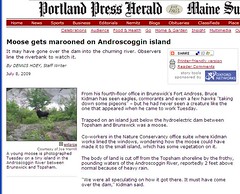
Moose in the Paper
Originally uploaded by Roadduck99

Yesterday was an exciting day at my office. A moose somehow found its way to a tiny island just below the Brunswick hydroelectric dam in the Androscoggin River between Brunswick and Topsham. Word traveled quickly and soon a steady stream of onlookers made their way to the Frank J. Wood bridge and the grounds of the Fort Andross Mill complex.


This is not normally moose country.

My office mates and I, however, didn't need to go anywhere. The window by my desk overlooks this very island. Most days we find ourselves looking for eagles or osprey, or the occasional sturgeon leaping out of the water. Today we had the best seats in the house to watch as the juvenile bull moose stood around, grazed on leaves, and bedded down for an afternoon nap. When Smilin' Dave (so named after two Niagara Falls daredevils) got up for an afternoon snack, I ran downstairs to get a better photo.

My co-workers, all keen observers of nature, observe keenly.

In a case of right place/right time, one of my photos made it into the Portland Press Herald. The lean times have left the paper short handed, and nobody was available to cover this story. So reporter Dennis Hoey called an associate of mine to get the details. Since the PPH had no camera on site, he asked if Bruce had a photo he would be willing to share. Bruce said no, "but I know somebody who did get a good shot." And the rest, as they say, is my 15 minutes of fame.

Labels: , ,

Sunday, June 14, 2009

Ecological Intelligence

“We have to stop speaking about the Earth being in need of healing. The Earth doesn’t need healing. We do.”

These words, from South African physician and naturalist Ian McCallum, close Daniel Goleman’s new book Ecological Intelligence: how Knowing the Hidden Impacts of What We Buy can Change Everything. Goleman’s book is an ambitious work that goes beyond the usual cries that humans are screwing up the planet and discusses how we can use market forces to change that behavior.

Not that Goleman ignores the fact that humans are screwing up the planet. (Or rather, screwing up the planet for humanity, as with the opening quote.) He goes into great detail to show how those of us in the US continue to pollute the air, ground, water and our bodies, long after science has shown us to be doing great harm. The reason for this is threefold: 1) Industry doesn’t change its practices because it might not be profitable to do so; 2) Government doesn’t regulate change, because political elections are financed by Industry; and 3) Consumers don’t insist on changes because we aren’t aware of the harm we are doing.

To combat this, Goleman introduces the reader to the concept of “Radical Transparancy,” wherein a product’s devalue (i.e. the harm it can do) is as readily known as its value. Studies have shown that if consumers are aware of the social, environment and especially health impacts of a product, most will change their purchasing habits even if it means spending more to buy the better product.

To illustrate, Goleman tells the tale of trans fat, which under the label “shortening” was a staple of home and industrial food production for 100 years. However, when the Institute of Medicine and the Food and Drug Administration independently issued reports at the turn of the 21st century detailing the health risks associated with trans fat, public concern reached heightened levels. When the FDA issued labeling requirements indicating the level of trans fat in foods, the agency in effect issued the death knell. Trans fat has been almost completely eliminated from foods in the US, because informed consumers do not want to buy products containing trans fats.

Not all stories are as cut-and-dried as that of trans fat. In some cases the risks are less immediate (global warming), or less personal (worker treatment), or less obvious (tainted water supplies).

To fully understand these risks, we need to understand more than simply how a product is made and how it is disposed of. We also need to understand what impacts result from the production of components, and of the subcomponents, and so forth. We also need to understand the impacts of shipping, packaging, and how the product is used. This is called “Life Cycle Analysis,” a cradle-to-grave study of a product’s impact.

One such study was made by the folks at Proctor & Gamble, who discovered that the greatest impact from its production of Tide laundry detergent was in the way the product was used. More specifically, the energy required to heat the laundry water was greater than the impacts incurred in manufacturing and transporting the product. This inspired P&G to develop a detergent that is just as effective using cold water.

Goleman treats the reader to several such anecdotes, and highlights several companies in addition to Proctor and Gamble (like Interface and (gulp!) Wal Mart) that have taken it upon themselves to improve the impacts of their businesses. Goleman also discusses the way that the US Government’s loose approval guidelines, the phenomenon of Unintended Consequences, and the corporate practice of “Greenwashing,” make it more difficult for the consumer to fully understand the impact of their purchasing practices. Thus the need for Radical Transparency.

Ecological Intelligence does a thorough job of describing the perils that face the unwitting consumer in the United States, and how industry and government work in tandem to obfuscate those perils. The reader comes away understanding that the threats to our health, the environment, and the people in third-world countries are real and avoidable. Where the book falls somewhat short is in offering solutions. This is because the Radical Transparency industry is in its infancy. The resources available to the consumer are not easily accessed at the point of sale (or, more importantly, in the aisle when the shopper is making a decision). Those that do exist still have large gaps in compiling the massive amounts of data on all products available for sale in the US.

This is an important book, and perhaps the first step in bringing the need for Radical Transparency into the collective consciousness. I believe that the population of this country is grossly unaware of the true impact of the way that we live. With the government beholden to industries that are unwilling to make risky changes that might impact the bottom line, the impetus for change must come from the grassroots. I believe that an educated population will generate the force required to shift the markets. We just need the information.

The following web sites are referenced in Goleman’s book. They have their shortfalls, but begin to provide the information that will help us change the way business is done in the US.

http://www.goodguide.com/ to find safe, healthy and green products.

http://www.cosmeticsdatabase.com/ for Skin Deep, the Cosmetics Safety Database.

Labels: , , ,

Thursday, June 11, 2009

The Termite

One of the great things about the organization that I work for is that I get to meet a lot of cool people who are doing a lot of cool things. One such cool thing was introduced by our Board member Ford Reiche, who is the CEO of Safe Handling, Inc., a transportation company in Auburn, Maine.

Ford recently became the proud owner of the Termite, a pickup truck that is powered through wood gasification technology. Ford bought the truck from a gentleman in Alabama who developed the technology through years of trial and error. Ford and his son George recently flew to Alabama and drove the Termite home - several hundred miles almost completely powered by scrap wood. What the Termite lacks in sophistication, she more than makes up for with innovation and efficiency - harmful emissions are lower than even hybrid vehicles.

Ford showed off his baby at a recent board meeting at the Samoset Resort in Rockland, Maine. The story of the technology, the guy who built this machine, and the misadventures encountered on the drive home, are best shared directly through his own blog. Here I will share a few photos that I took while he was showing off this baby the other day.


That's the engine in back - hay filter, heat exchanger and burn chamber. The termite gets about one mile per pound, or 40 miles per "tank" of scrap wood.


The rails are actually the radiator that cools the engine. The bright green paint is simply eye-catching.

Ford Reiche, looking every bit the mad scientist.

The gauges must be read through the rear view mirror. They are scaled differently as well.

Labels: ,

Monday, June 08, 2009

Garden Update


Square Foot 0604
Originally uploaded by Roadduck99

It’s been about a month since I started this year’s garden, so I thought I would provide an update. It’s my first time trying the Square Foot Gardening method. The originator of this method, Mel Bartholomew, promises that SFG is a fairly low-maintenance method of growing vegetables, and so far I am finding that to be the case.

Of course there is the original work involved in assembling the boxes, mixing the soil and filling the boxes. In reality, accumulating the required materials takes as much time as assembling everything at home. If you want to do this on the ultra-cheap and find people who will give you scrap materials, it will probably take more time. But time is money, and I was willing to pay for convenience.

I also knew that I was going to want to put trellises on my boxes in order to grow tomatoes, beans and cucumbers vertically. Since it was going to be awhile before anything would be ready to climb, I didn’t let the lack of trellises keep me from planting.

In early May, I put in cold-tolerant plants: broccoli, onions, shallots, carrots and several varieties of lettuce. Unfortunately, we have a groundhog in the area who doesn’t understand boundaries, but who also happens to enjoy greens. The groundhog slowed the development of the lettuces and offed one of the two broccoli plants. This necessitated a deterrent. So when I put up the trellises, I also jerry-rigged some posts to hold up bird netting to keep the pests out. This was meant to be a temporary fix, but it seems to be doing well in keeping the rodents away, so I am taking my time with the upgrades.

Over Memorial Day weekend I put in a few other plants – two tomato plants, a pepper plant, basil and swiss chard. I also planted seeds to grow pest-deterring marigolds and zinnias. A week later I planted pole beans and cucumbers. I have also relocated some parsley that was in another garden bed and which also turned out to be on the groundhog’s menu.

Checking in today, things have really started to grow. The cukes finally popped out of the ground the other day, and so everything is off and running now. Free from groundhog nibbles, the lettuce is going strong, and the broccoli (including a seedling I purchased to replace the one that didn’t make it) is growing fast. The seeded items are all up and making their way. We’ve even harvested some lettuce leaves to put in our salads, though we don’t have enough yet to preclude our buying store-bought greens. And I have a couple squares still available for later plantings of lettuce or broccoli, or maybe something else altogether.

Mel promises very little weeding because we start with weed-free soil. That’s mostly true, though he maybe didn’t anticipate that my own compost might have some still-viable seeds in it, or that the maple tree in my back yard would be dumping dozens of seeds on the garden. The good news is that the weeds are easy to see and, since they aren’t embedded in the soil, easy to pull.

All in all, the first month with the new garden has been very gratifying. I look forward to sharing more results in the future.

Labels: ,

Wednesday, June 03, 2009

You don't have a vote in the matter

Rush might support Sonia Sotomayor for the Supreme Court. This is big news, despite the fact that he's an entertainer and, therefore, his position doesn't matter.

Perhap's he's engaging in some reverse-psychology - if the Dems believe Sotomayor is cool with the far right, they might start to think that she's not a good choice after all.

Labels: ,

Wednesday, May 27, 2009

Open the door.


Doorknob
Originally uploaded by Roadduck99

If you’re still with me on this thing, be advised that what follows isn’t what you’ve come to expect from me. This isn’t intended to be a naval-gazer blog. Sometimes that’s just what’s needed.

I’m looking for a door to open. I think there’s one around here someplace, and perhaps it’s already open, like the one in the photo. Perhaps, like the photo, there’s a window that reveals what is on the other side, and perhaps the door is already open wide enough that the outside is reflected in the doorknob. And perhaps it has been there all along, but I’ve only seen the door separating me from the other side and never looked closely enough to notice the knob was ready for me to turn.

The 12 months or so have been difficult for me. Almost exactly a year ago, my wife and I moved into a new house in the heart of town. This was supposed to be an exciting new beginning, with a smaller mortgage and a smaller commute. What it has turned into, for me, has been a lot of dissatisfaction. I’ve had difficulty sorting out priorities and setting goals, or even seeing the value in doing so. I haven’t given the attention deserved by my marriage, my job, or myself. I have sought counsel to sort things out. I have, I am sad to say, come away with a lesser opinion of myself.

I have discovered that the doors I believed were keeping me out of a good place, may in fact be keeping me in a bad place. I don’t need to arrive so much as I need to escape.

I began this blog because I had stories to tell. I have not been allowing myself to tell these stories for a couple of years now. I have many excuses, but it doesn’t seem important to hash through those here. I’ve got people with whom I can discuss those. In recent months I have taken up telling stories through photographs that I post at flickr. The doorknob photo, I think, tells more of a story about me than about the old building that houses it. (The farmhouse at the McLaughlin Garden in South Paris, if you’re curious.) Other photos that I have posted tell stories about my gardens at home and the world that I see around me.

They say a picture tells a thousand words. I like them because, though I have much to learn, a photograph can be quick and easy to produce. They are also quick and easy for many people to enjoy. Writing, for me, is usually fairly quick and easy, too. When I have a story to tell, I can produce half a picture in a fairly short amount of time. But somewhere along the way I have closed myself in a room thinking that it’s not so quick and easy to write – not if I want to “do it the right way.” But I think it’s time to try turning the knob and see if the door will open.

I have stories to tell. I won’t be telling one every day, and not all will appear here, but I will be telling them. The door is open.

Labels: , ,